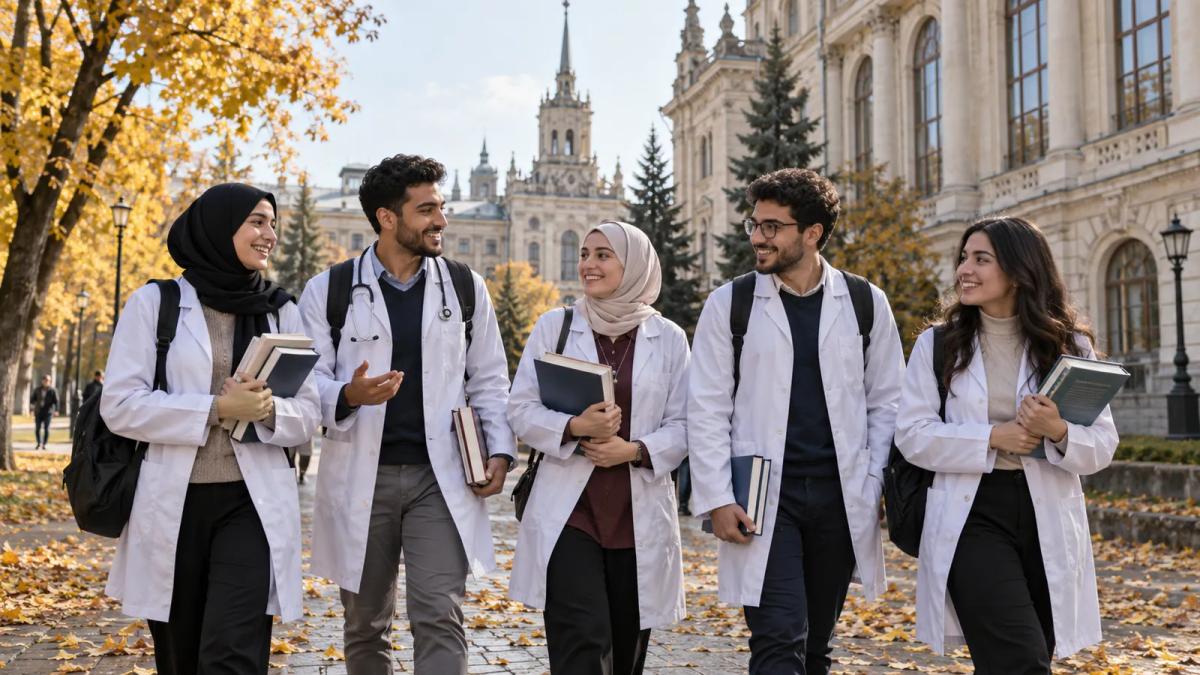
Guide to Studying Medicine in Russia for International Students: Top Universities, Costs, and Admission Requirements
- Meriem M.
- Updated 7 September 2026
- 9 min read
Table of contents7
Studying medicine in Russia has become a prominent choice for international students, particularly those from Arab and African countries. This popularity stems from the high quality of education, relatively affordable tuition fees compared to Western nations, and the wide array of internationally recognized medical universities. Russian institutions offer medical programs in both Russian and, increasingly, English, making them accessible to a broader student body.
This comprehensive guide provides all essential information for prospective students considering medical studies in Russia. We will cover admission requirements, study duration, top universities, tuition costs, and important considerations to ensure you make an informed decision.

✅ Why Choose to Study Medicine in Russia?
Russia offers a compelling proposition for international students aspiring to become doctors. Its medical education system is known for its academic rigor, comprehensive curriculum, and practical training opportunities. Many Russian medical universities hold international accreditations, and their degrees are recognized in numerous countries worldwide. The significant advantage lies in the balance between high-quality education and considerably lower costs compared to institutions in Europe, North America, or even some parts of Asia. This makes studying medicine in Russia an attractive and viable option for many.
🎓 Admission Requirements and Study Duration
Admission to medical programs in Russia is generally more flexible for international students compared to other countries. Most medical universities accept high school leaving certificates with an average score of 70% or higher, particularly in science subjects. However, highly prestigious universities like Sechenov and Pavlov, especially for English-taught programs or highly competitive fields, may require scores between 80% and 90%.
📅 Duration of Medical Study
General Medicine Program: Typically lasts 6 years. This includes intensive theoretical study in subjects like anatomy, physiology, biochemistry, pathology, and pharmacology, alongside practical training that usually begins in the third or fourth year in university hospitals.
Preparatory Year (for Russian-taught programs): An additional 1 year preceding the main academic program. During this year, students learn academic Russian, medical terminology, and review subjects like biology and chemistry. This extends the total study duration to 7 years for those opting for Russian-taught courses.
Internship: A mandatory clinical training phase after completing the core program, focused on enhancing practical skills and gaining clinical experience with patients.
Residency: For students wishing to specialize (e.g., surgery, pediatrics, cardiology). This program typically ranges from 2 to 5 years, depending on the chosen specialization, providing advanced training for professional practice.
🏫 Top Medical Universities in Russia
Russia boasts several distinguished medical universities renowned for their academic excellence and international recognition. Here are four of the leading institutions:
1. Sechenov University (First Moscow State Medical University)
As Russia's oldest medical university, established in 1758, Sechenov University offers unparalleled academic excellence and over 265 years of medical education and research experience. Located in Moscow, it provides a diverse and advanced learning environment.
Academic Heritage: Over 265 years of experience in medical education and research.
Diverse Programs: Offers general medicine, dentistry, pharmacy, nursing, public health, biomedical sciences, and postgraduate programs.
English-Taught Programs: Available for medicine and dentistry, making it suitable for international students.
Dedicated Preparatory Year: Helps foreign students learn Russian and medical terminology.
Wide International Recognition: Recognized in many Arab countries (Saudi Arabia, UAE, Egypt, Iraq, Jordan) and across Europe and Asia.
Advanced Practical Training: High-quality clinical training in university hospitals and research centers from early years.
Multicultural Environment: Attracts students from over 80 countries.
Comprehensive Support: Guidance, accommodation, and organizational services for international students.
2. Pavlov First Saint Petersburg State Medical University
Founded in 1897 and named after Nobel laureate Ivan Pavlov, this university in Saint Petersburg is a prestigious institution known for strong academic training and outstanding practical experience.
Rich History and Academic Quality: Over 125 years of excellence in medical education.
Modern Curricula & Intensive Clinical Training: Utilizes modern teaching methods, simulation technologies, and practical training in advanced university hospitals from early years.
Multiple Specializations: Includes general medicine, dentistry, pharmacy, nursing, public health, biomedical sciences, and postgraduate programs.
English-Taught Programs: International programs in medicine and dentistry, with opportunities to learn Russian.
Broad International Recognition: Recognized in many Arab, European, and Asian countries, facilitating diploma equivalence.
Research Opportunities & Student Exchange: Participates in international research projects and exchange programs.
Integrated Support: Dedicated services for foreign students from admission to graduation.
3. Kazan State Medical University
Established in 1814, Kazan State Medical University is one of Russia's oldest and most respected medical institutions. Located in Kazan, a safe, multicultural city with moderate living costs, it offers a comfortable study environment.
Ancient Academic Heritage: Over 200 years of experience in medical and health sciences education.
Diverse Medical Specializations: Offers programs in general medicine, dentistry, pharmacy, nursing, public health, and biomedical sciences, along with postgraduate degrees.
English-Taught Programs: Available for some specializations like medicine and dentistry.
Advanced Clinical Training: Strong partnerships with teaching hospitals and medical centers for practical training from early years.
Extensive International Accreditation: Recognized by WHO and academic bodies in Saudi Arabia, UAE, Egypt, Iraq, Jordan, among others.
Global Outreach: Welcomes students from over 50 countries, providing comprehensive support services.
Comfortable & Safe Student Environment: Offers comfortable student accommodation and diverse cultural activities.
4. Novosibirsk State University
Founded in 1959 within the renowned "Akademgorodok" scientific hub, Novosibirsk State University is a leading institution integrating education and research from day one. Located in Novosibirsk, Russia's third-largest city, it offers a unique academic and practical experience.
Strong Focus on Scientific Research: Integrates academic education with research participation from early years.
Advanced Medical & Biological Programs: Includes general medicine, biomedical sciences, medical physics, pharmacy, biochemistry, and genetic engineering.
Modern Laboratories & Effective Practical Training: Students train in advanced research facilities and well-equipped teaching hospitals.
English-Taught Programs: Some international programs are available in English, alongside preparatory Russian language courses.
Diverse International Community: Attracts students from over 50 countries, offering comprehensive support services.
Active Educational Environment: Hosts scientific conferences, cultural events, and workshops.
💰 Costs of Studying Medicine and Living in Russia
One of the most attractive aspects for international students considering medical studies in Russia is the financial advantage. Russia offers high-quality medical education at significantly lower costs compared to Western Europe, the USA, or even some Asian countries. This affordability does not compromise educational quality, primarily due to substantial government support for universities and generally lower living expenses.
Annual Estimated Costs:
Steps
- 1
Tuition Fees
Range from 3,000 to 7,000 USD annually . These costs vary based on the university, city, and language of instruction. English.taught programs are often more expensive than Russian.taught ones.
- 2
University Accommodation
Most universities offer affordable on.campus housing, typically ranging from 300 to 800 USD annually . Rooms can be single, double, or triple.
⚠️ Challenges and Important Considerations
While studying medicine in Russia offers numerous benefits, it's crucial to be aware of potential challenges to form a complete picture before making a decision:
Russian Language Necessity for Practical Training: Even if you study in English, mastering Russian is essential for effective communication with patients and medical staff during hospital placements. The language is also a vital part of daily life, requiring significant effort to learn.
Differences in the Education System: Russian universities often emphasize theoretical study in the early years, with practical training introduced later. The system relies heavily on self-learning and oral examinations, which may differ significantly from educational systems in Arab or Western countries.
Diploma Equivalence Challenges: Despite international recognition, obtaining diploma equivalence in some Arab countries often requires passing national examinations (e.g., Prometric, DHA, or Egyptian equivalence exams). This necessitates intensive preparation. Furthermore, it is crucial to verify the accreditation of your chosen Russian university with the official bodies in your home country before enrollment.
Harsh and Cold Climate: Russian winters are long and severe, with temperatures potentially dropping to -30°C. Adapting requires mental and physical preparation, as well as appropriate clothing, and can affect some students' well-being.
📝 Practical Advice for Aspiring Students
Checklist
Start Learning Russian Early: Even if you plan to study in English, basic Russian will greatly enhance your daily life and practical training.
Research University Accreditation: Always confirm that your chosen university's degree is recognized in your home country by contacting the relevant official authorities.
Prepare for Cultural and Climatic Adjustment: Be ready for a new cultural experience and the cold Russian winter.
Financial Planning: While affordable, ensure you have a clear financial plan covering tuition, accommodation, and living expenses.
❓ Frequently Asked Questions (FAQ)
Q1: What is the required admission rate for studying medicine in Russia?
A1: Most universities require a high school average of 70% or higher in science subjects. Top universities or English-taught programs may require 80-90%.
Q2: How long does it take to study medicine in Russia?
A2: The general medicine program is 6 years. If a preparatory year for Russian language is needed, it extends to 7 years. This is followed by an internship and then residency for specialization.
Q3: Can I study medicine in Russia in English?
A3: Yes, several prominent universities offer medical programs in English, though these may have higher tuition fees and stricter admission requirements.
Q4: Is a Russian medical diploma recognized internationally?
A4: Many Russian medical universities are internationally recognized. However, diploma equivalence in your home country may require passing national licensing exams. Always verify recognition with your country's official medical or higher education authorities.
Embarking on a medical journey in Russia can be a transformative experience. With thorough preparation and the right information, you can successfully navigate the application process and achieve your academic goals. Explore more resources and tools on ElWijha to assist you further in your study abroad journey.
Tags
Next step
Turn this guide into your application
Prepare your CV, letters and documents with the El Wijha tools.