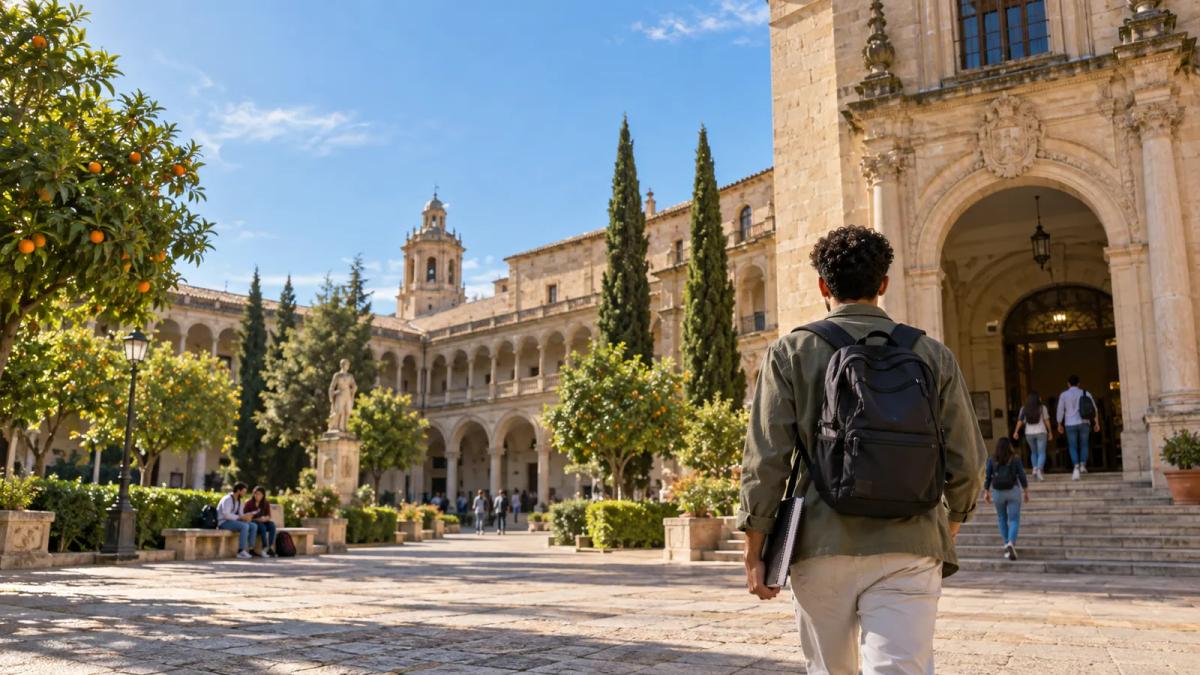
Want to Study in Spain? A Complete Guide to Universities, Costs, and Scholarships
- Meriem M.
- Updated 6 September 2026
- 10 min read
Table of contents8
Spain, located in the southwestern tip of Europe, bordered by France to the north and Portugal to the west, with coastlines on the Mediterranean Sea to the east and the Atlantic Ocean to the west, and facing Moroccan shores across the Strait of Gibraltar, offers much more than just its renowned football clubs. It presents a vibrant landscape for academic and cultural enrichment. For students from the Maghreb, Arab, and African regions, Spain stands out as an attractive destination for higher education, blending quality academics with a rich cultural experience.
This comprehensive guide provides all the essential information you need to consider studying in Spain, from its unique educational advantages to university options, financial considerations, scholarship opportunities, and visa requirements.
✅ Why Choose Spain for Your Studies?
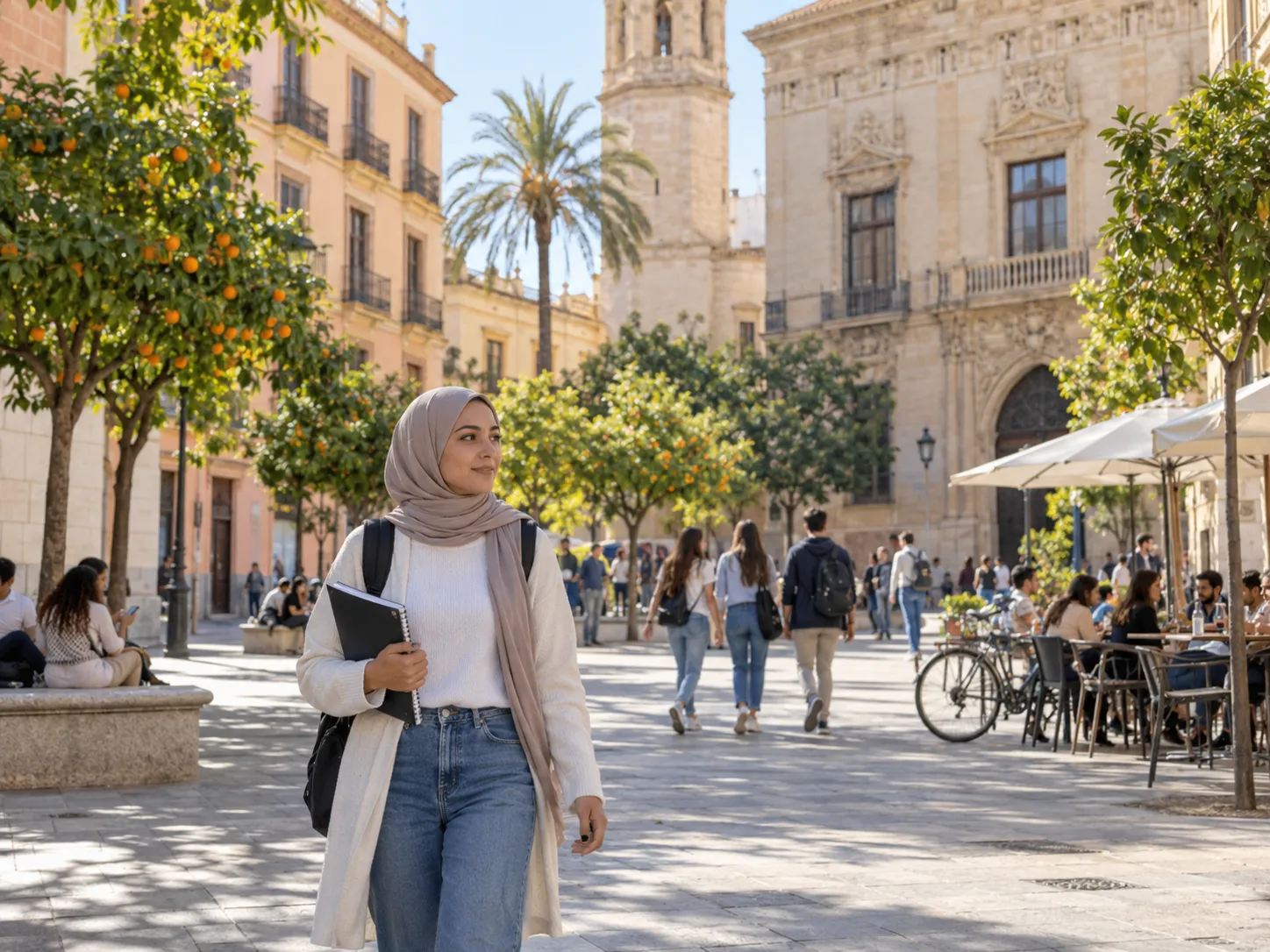
Each year, thousands of international students flock to Spain's 74 universities, drawn by a myriad of benefits that make it a premier study destination. Here are some key advantages:
🎓 Distinctive Educational System
Spain offers an excellent learning environment, regardless of your chosen university or specialization. Its well-structured educational system is designed to provide maximum learning opportunities across all academic levels. Spain is also the third most popular country globally for international studies, with 36% of its international students originating from America (as per source data).
🌍 A Blend of Education and Tourism
Beyond academic pursuits, studying in Spain is an opportunity for cultural immersion and exploration. While cities like Madrid and Barcelona are famous, Spain boasts countless other cities and tourist attractions. Your time in Spain will not only be an educational journey but also a chance to enjoy its diverse landscapes, from vibrant city life to serene countryside, and beautiful coastlines.
🎭 Diverse Entertainment Options
No matter where you reside in Spain, you'll find an abundance of engaging activities and sights. Its proximity to France and the UK also makes quick trips to Paris or London easily accessible. Other entertainment avenues include art exhibitions, museums, parks, markets, restaurants, and cafes.
🗣️ An Opportunity to Learn and Practice Spanish
While learning Spanish might not be your primary goal, you will undoubtedly acquire a significant portion of this beautiful language. Spanish is one of the most widely spoken languages globally, after English and Chinese. It is considered relatively easier to learn for European language speakers compared to French or Italian, and notably, it incorporates a significant number of words derived from Arabic, making its acquisition an enjoyable and accessible endeavor.
💰 Affordable Cost of Living
Compared to many other European countries, Spain offers a relatively lower and more manageable cost of living. This is a crucial advantage for international students, who often face financial constraints while studying abroad. Most cities in Spain allow students to manage their finances effectively, often better than in other European nations.
☀️ Pleasant Climate
Living in Spain allows you to experience four distinct seasons with pleasant weather. Winter temperatures average around 15°C, rising to about 21°C in summer, making it suitable for various activities. It's worth noting that the climate varies across regions, so researching the specific weather patterns of your chosen city is advisable.
💸 Moderate University Fees
In addition to relatively low living costs, university tuition fees in Spain are generally affordable. They typically range from 5,500 to 12,000 Euros annually, which is considerably less than the costs of studying in many other European countries and the United States.
🎓 The Higher Education System in Spain
Higher education in Spain adheres to the European Bologna Process, structured into three main cycles:
1. Bachelor's Degree (Grado): Typically lasts 3 to 4 years and is based on the European Credit Transfer and Accumulation System (ECTS).
2. Master's Degree (Máster): Ranges from one to two years, focusing on academic or professional specialization.
3. Doctoral Degree (Doctorado): Generally takes 3 to 4 years, with a strong emphasis on scientific research.
🏫 Leading Universities in Spain
Spain boasts several highly-ranked institutions offering excellent programs across various fields. Here are some of the top universities you might consider for your Bachelor's, Master's, or Doctoral studies:
1. Pompeu Fabra University (Universitat Pompeu Fabra)
Established in 1990 in Barcelona, this public university was nominated for the "International Excellence" award by the Spanish Ministry of Education in 2010. It was ranked as the best university in Spain by the QS World University Rankings 2020.
2. Autonomous University of Madrid (Universidad Autónoma de Madrid - UAM)
Founded in 1986, UAM was ranked 159th globally by QS in 2019. It comprises 8 main faculties and hosts over 36,000 students. Its Faculty of Law is particularly renowned.
3. University of Barcelona (Universitat de Barcelona)
Founded in 1450, the University of Barcelona is one of the oldest and most prestigious universities globally. It ranked 2nd in Spain and 166th worldwide by QS in 2019. Today, it has over 63,000 students across 16 faculties and more than 106 departments.
4. Autonomous University of Barcelona (Universitat Autònoma de Barcelona - UAB)
Established in 1968, UAB ranked 193rd globally and 3rd in Spain by QS in 2019. With approximately 40,000 students, it is one of the few Spanish universities with a central campus housing all faculties, research centers, and academic activities.
5. Complutense University of Madrid (Universidad Complutense de Madrid - UCM)
Dating back to 1293, UCM is Spain's oldest university and one of the world's most venerable institutions, hosting over 86,000 students. It ranked 206th globally and among the top 50 universities for Dentistry. Notably, it was the first university in the world to award a doctoral degree to a woman in 1785.
6. University of Navarra (Universidad de Navarra)
Founded in 1952, this private university has its main campuses in Pamplona and San Sebastián. It enrolls over 11,000 undergraduate and postgraduate students, including a significant number of international students, and was ranked 242nd globally by QS in 2019.
💰 Study and Living Costs in Spain
Understanding the financial aspects is crucial for planning your studies abroad. Spain is considered a low to moderate-cost destination for international students.
💸 Tuition Fees
University fees in Spain vary based on several factors:
Type of Institution: Public or private.
Degree Level: Bachelor's, Master's, or Doctorate.
Location: City/region of study.
Student Nationality: Fees for non-EU international students are typically 1,000-1,500 EUR higher, sometimes even double.
Average Tuition Fees:
Public Universities:
Bachelor's Degree: 150 - 3,500 EUR annually.
Master's Degree: 300 - 3,500 EUR annually.
Private Universities:
General programs: Up to 20,000 EUR annually.
Business schools/programs: Up to 25,000 EUR annually.
MBA programs: Up to 30,000 EUR annually.
Universities with Relatively Lower Costs:
University of Granada: Average 821 EUR/year.
University of Valencia: Around 2,600 EUR/year.
University of Santiago de Compostela: Approximately 1,600 EUR/year.
Rovira i Virgili University: Around 2,900 EUR/year.
Costs at Renowned Spanish Universities:
Autonomous University of Madrid: 2,000 to 3,000 EUR/year.
Pompeu Fabra University: Approximately 3,500 EUR/year.
🏡 Cost of Living and Accommodation
Spain is known for its relatively affordable living costs, allowing international students to manage their finances without excessive strain. You will generally need approximately 900 to 1,100 EUR per month for living expenses.
Higher Costs: Madrid and Barcelona are the most expensive cities.
Lower Costs: Cities like Valencia or Seville offer lower living costs, ranging from 700 to 900 EUR per month.
Accommodation Options:
Student Residences (Residencias de Estudiantes): 360 - 650 EUR per month.
Private Apartments: 200 - 1,000 EUR per month (varying by size and location).
Homestay with a Spanish Family: Prices vary based on region, living conditions, and included services.
🛒 Additional Expenses
Consider these monthly estimates for other essential costs:
Utilities (electricity, water, heating, etc.): Around 115 EUR per month.
Internet Services: Approximately 30 EUR per month.
Food: 200 - 400 EUR per month (depends on personal habits and dining choices).
Books and Educational Materials: Approximately 900 EUR annually.
Health Insurance: 70 - 180 EUR annually.
🎁 Scholarship Opportunities in Spain
Securing a scholarship can significantly alleviate the financial burden of tuition and living costs. Here are some prominent scholarships available to international students in Spain:
🇪🇺 Erasmus Mundus Scholarships
The European Union funds international students pursuing Master's and Doctoral degrees in Europe through the Erasmus Mundus program. This financial support is available to students from both EU and non-EU countries, with numerous opportunities to study in Spain.
💼 African Leadership in Business Program
These scholarships are specifically offered to African students aspiring to pursue an MBA at a Spanish university.
🔬 University of Granada Research Fellowship
This 36-month research fellowship is offered by the University of Granada and targets international PhD students from around the world, providing approximately 6,800 USD annually.
📝 Application Requirements and Student Visa for Spain
Navigating the application and visa process is a critical step for international students.
📋 Essential Documents for University Application
While requirements may vary slightly by university, the following documents are generally needed:
DELE Certificate: Proof of Spanish language proficiency, obtainable from a local Cervantes Institute.
English Language Proficiency Certificate: Such as TOEFL or IELTS, depending on the university's requirements. These can be obtained from Amideast centers, ETS for TOEFL, or the British Council for IELTS.
Previous Academic Certificates: Authenticated and legalized by your local consulate.
Statement of Purpose (Motivation Letter): Explaining your academic goals and reasons for choosing the program/university.
Letters of Recommendation: Two academic letters from former university professors.
Letters of Recommendation (Optional): Two letters from previous employers, if applicable (for some programs).
Curriculum Vitae (CV).
Portfolio: If applicable to your field of study.
🛂 Student Visa Requirements
To obtain a student visa for Spain, you will typically need to schedule an appointment with the Spanish embassy or its affiliated visa application center in your home country. The specific requirements may vary, but generally include:
University Acceptance Letter: Official confirmation of admission from a Spanish educational institution.
Visa Application Form: Obtainable from the embassy's website or the visa center.
Passport-sized Photos: Two recent photos with a white background.
Valid Passport: With sufficient validity beyond your intended stay.
Proof of Financial Means: To cover your tuition and living expenses.
Health Insurance.
Criminal Record Certificate.
Medical Certificate.
❓ Frequently Asked Questions About Studying in Spain
Is it mandatory to speak Spanish to study in Spain?
While many programs are offered in English, learning Spanish is highly recommended and often necessary for daily life. Proficiency in Spanish (DELE) is a common requirement for many university programs, especially at the Bachelor's level.
What is the average monthly cost of living for a student in Spain?
The estimated monthly cost of living for a student in Spain ranges from 900 to 1,100 EUR, though this can be lower (700-900 EUR) in smaller cities outside Madrid and Barcelona.
Are there scholarships available for international students in Spain?
Yes, Spain offers several scholarships for international students, including the EU's Erasmus Mundus program, specific programs for African students like the African Leadership in Business, and research fellowships such as those offered by the University of Granada.
🔗 Embark on Your Spanish Academic Journey
Studying in Spain offers a unique blend of academic excellence, cultural immersion, and an enriching lifestyle, all at a relatively affordable cost compared to many other European destinations. With its welcoming atmosphere, diverse cities, and esteemed universities, Spain is an ideal choice for students seeking a transformative international education experience.
Ready to take the next step? We invite you to explore the wide range of scholarship opportunities and detailed guides available on the ElWijha platform to help you realize your dream of studying in Spain.
Tags
Next step
Turn this guide into your application
Prepare your CV, letters and documents with the El Wijha tools.