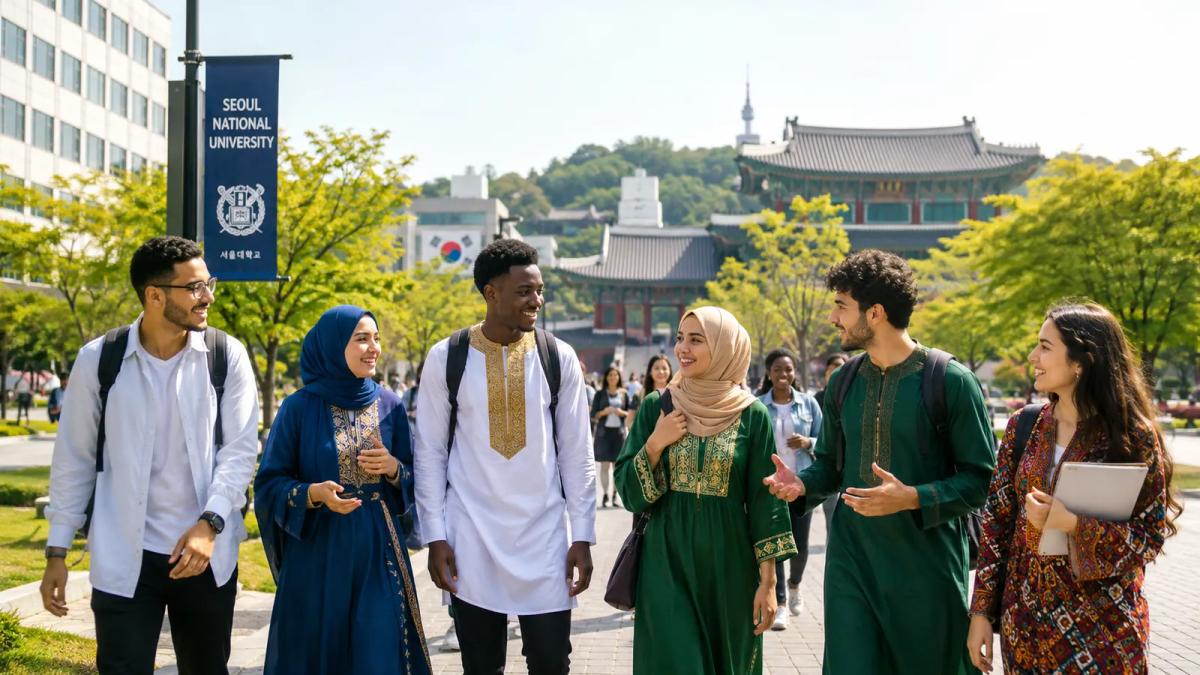
Guide to Studying in South Korea: From Choosing a University to Job Opportunities
- Salma R.
- Updated 13 October 2026
- 6 min read
Table of contents9
South Korea, a vibrant nation nestled in East Asia on the Korean Peninsula, offers a compelling destination for international students. Bordered by China to the west across the East China Sea, Japan to the east across the Sea of Japan, and North Korea to the north, its strategic location is matched by its dynamic economy and rich cultural heritage.

With an area of approximately 100,000 square kilometers and a population of around 52 million, South Korea has made significant strides in various sectors. Education, in particular, is highly valued, evidenced by its 22nd ranking in the 2019 UNDP Human Development Index.
🌍 Why Choose South Korea for Your Studies?
✅ An Economic Powerhouse and Educational Hub
Since the division of the Korean Peninsula in 1948, South Korea has emerged as an 'Asian Tiger,' excelling notably in technology and education. Its capital, Seoul, is consistently ranked among the top 10 best cities for students globally. As the world's eleventh-largest economy, South Korea fosters an environment of innovation, encouraging students to think beyond conventional boundaries and embrace creativity.
🎓 A Welcoming Destination for International Students
The Korean government is actively working to enhance its global academic presence. It aims to increase the number of international students from 123,000 to 200,000 by 2023, reflecting a strong commitment to internationalizing knowledge and forging new global connections. This initiative underscores the country's dedication to creating a diverse and inclusive academic environment.
💡 Global Opportunities Through Leading Companies
South Korea's policy of global engagement, particularly in recent years, is supported by its giant corporations like Samsung and Hyundai, which have a presence worldwide. This global reach not only boosts the nation's economy but also significantly expands educational and employment prospects for students and graduates.
⚠️ Potential Challenges for International Students
🗣️ The Korean Language Barrier
While South Korea offers numerous advantages, prospective students should be aware of certain challenges. The Korean language is considered complex, and its global reach is limited compared to languages like English or Mandarin. This can pose a significant hurdle for daily life and academic integration. The article suggests that learning Chinese might offer broader benefits due to China's vast economy, though it notes that studying in China can be more expensive.
💰 Scholarship and Job Limitations
The Korean government's efforts to promote its language and culture mean that many scholarships prioritize applicants proficient in Korean or those who demonstrate a strong interest in learning it. Consequently, students opting for English-taught programs might find fewer scholarship opportunities and potentially limited job prospects, as the government's primary goal is often the dissemination of Korean culture and language.
🏫 Top Universities in South Korea
South Korea is home to several world-class institutions:
Seoul National University (SNU): Established in 1946, it holds the top spot in South Korea and ranks 129th globally. Located in Seoul.
Sungkyunkwan University: Founded in 1398, it is the second-highest-ranked university in South Korea and 188th worldwide. Located in Seoul.
Korea Advanced Institute of Science and Technology (KAIST): Established in 1971, it ranks third in South Korea and 217th globally. Located in Daejeon.
Korea University: Founded in 1905, it is the fourth-ranked university in South Korea and 276th worldwide. Located in Seoul.
Yonsei University: Established in 1885, it ranks fifth in South Korea and 316th globally. Located in Seoul.
💸 Understanding Study Costs in South Korea
The cost of education in South Korea varies depending on the program and institution:
Bachelor's Degree (Humanities): Tuition ranges from approximately $1,600 to $7,400 per semester.
Science, Medical, and Engineering Programs: Tuition can go up to $10,000 per semester.
On-campus Accommodation: Costs typically range from $280 to $700 per month.
Transportation: Around $50 per month.
Living Expenses (Food): Approximately $260 per month, especially if utilizing more affordable university meal options.
💰 Scholarship Opportunities
While the South Korean government, through the National Institute for International Education (NIIED), offers various scholarships, only a limited number are specifically targeted at Arab countries, with a primary focus on Asian nations. However, some opportunities are available:
GKS Summer Program: Primarily for students from Africa and Latin America. North African Arab students may apply, but priority is often given to those proficient in Korean. This scholarship does not cover airfare.
Government Summer Support Program for Foreign Exchange Students: This scholarship lasts for 4 or 10 months, providing $600 per month and a round-trip air ticket.
📝 Application Process for Studying in South Korea
The application process is streamlined through the official Korean government online platform. Applicants can select their desired major and university, complete the application form, and upload necessary documents such as previous academic certificates, transcripts, and course syllabi.
Depending on the language of instruction, applicants may need to pass language proficiency tests: the TOPIK (Test of Proficiency in Korean) for Korean-taught programs, or TOEFL/IELTS for English-taught programs. The official 'Study in Korea' website allows prospective students to search for universities offering programs in English.
📋 Student Visa Procedures
International students require specific visas for their studies in South Korea:
D-2 Visa: For university-level academic studies.
D-4-1 Visa: Specifically for Korean language training programs.
It is advisable to consult the Korean Immigration Service website for comprehensive details. Typically, official documents such as a passport and personal photos are required. Students should also contact their local Korean Embassy for precise and up-to-date requirements.
💼 Work Opportunities for Students
The South Korean government permits international students to work during their studies. Furthermore, the Korea Trade-Investment Promotion Agency (KOTRA) and the National Institute for International Education (NIIED) jointly organize an annual job fair specifically for international students, attracting over 100 participating companies. This event provides a valuable platform for students to submit their resumes and conduct job interviews across various sectors.
❓ Frequently Asked Questions (FAQ)
Is it expensive to study in South Korea?
Tuition costs vary, ranging from $1,600 to $7,400 per semester for humanities and up to $10,000 for science, medical, and engineering programs. Living expenses, including housing and transportation, are additional.Do I need to speak Korean to study there?
While many programs are taught in English, proficiency in Korean (TOPIK) can significantly enhance scholarship opportunities and daily life. The government prioritizes Korean language and culture promotion.Can international students work in South Korea?
Yes, the government allows international students to work. There are also annual job fairs organized to connect students with potential employers.
Explore your academic journey to South Korea with ElWijha. Our platform offers comprehensive resources to guide you through visa applications, university selection, and scholarship opportunities. Start planning your future today!
Tags
Next step
Turn this guide into your application
Prepare your CV, letters and documents with the El Wijha tools.