Moscow State Academy of Veterinary Medicine: Admission Requirements, Tuition Fees, and Study Guide
- Salma R.
- Updated 8 September 2026
- 8 min read
Table of contents5
🏫 About the Moscow State Academy of Veterinary Medicine
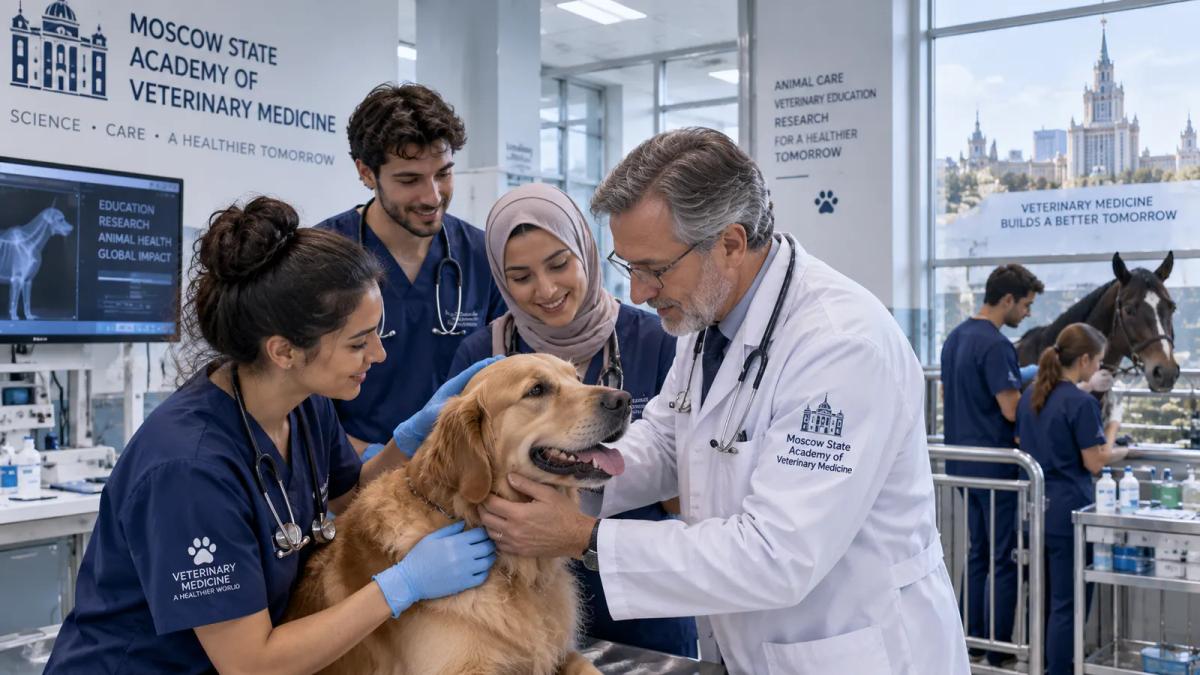
The Moscow State Academy of Veterinary Medicine (MGAVM) stands as one of the most prestigious and significant educational institutions in the field of veterinary medicine, not only in Russia but globally. Established at the beginning of the 20th century, the Academy boasts over a century of experience in delivering specialized education and training in veterinary sciences. It is recognized as a leading scientific and educational center, committed to providing an advanced learning environment that integrates theoretical knowledge with practical application across various veterinary domains.
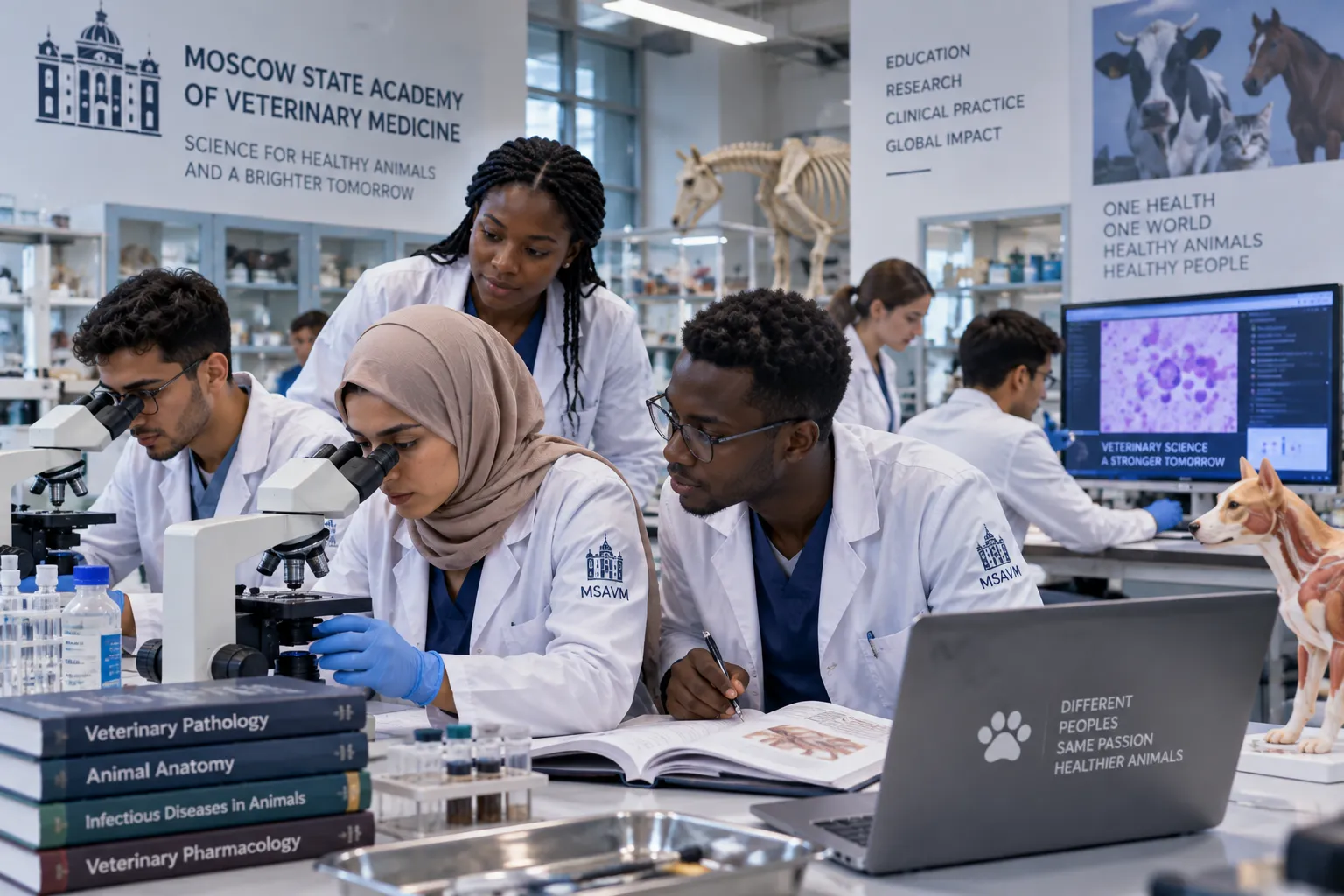
MGAVM offers a diverse range of academic programs covering all vital specializations in veterinary medicine. These include animal care and treatment, veterinary pathology, veterinary surgery, as well as specialized fields like veterinary pharmacology, public health, and advanced veterinary research. The Academy significantly contributes to the advancement of veterinary sciences through innovative scientific research aimed at resolving animal health issues and protecting wildlife.
The Academy prides itself on its faculty of distinguished professors and experts, which enhances the quality of education and equips students with the necessary skills to tackle modern challenges in veterinary medicine. Furthermore, MGAVM provides its students with practical training opportunities through its veterinary hospitals and advanced research centers, enabling them to gain hands-on experience crucial for their future professional performance.
✅ Admission Requirements: Your Path to Veterinary Studies
The Moscow State Academy of Veterinary Medicine offers outstanding academic programs at Bachelor's, Master's, and Doctoral levels. Admission requirements vary based on the academic program and nationality (Russian or international), but several general conditions apply to all applicants.
Academic Qualifications
For Bachelor's Programs: Applicants must have successfully completed secondary education or its equivalent, such as a General Secondary Education Certificate, International Baccalaureate (IB), or A-Levels. Required subjects typically include natural sciences (Chemistry, Biology, Physics), which are fundamental to veterinary medicine. Some programs may require specific grades in certain subjects.
For Master's Programs: A Bachelor's degree in Veterinary Medicine or a related field (e.g., Biological Sciences, Agricultural Sciences) is mandatory. Applicants might be asked to submit previous research projects, especially for research-oriented programs. Practical experience in the veterinary field may also be required for certain specializations.
For PhD Programs: A Master's degree in a relevant veterinary specialization is required. Applicants must submit a research proposal or study plan aligned with program requirements. Prior research experience or scientific publications can be a significant advantage.
Language Proficiency
Since most academic programs at MGAVM are taught in Russian, proficiency in the Russian language is essential, particularly for international students.
For International Applicants: A certificate demonstrating Russian language proficiency, such as TORFL (Test of Russian as a Foreign Language), is required. Students without sufficient Russian knowledge can enroll in a preparatory language year at the Academy or another accredited institution in Russia.
English-Taught Programs: While some programs might be available in English, this depends on the specific program and specialization. It is advisable to contact the Academy directly to confirm the availability of English-taught options.
Entrance Exams and Interviews
Applicants may be required to pass entrance examinations and personal interviews to assess their academic and professional capabilities.
Entrance Exams: These typically evaluate knowledge in core veterinary subjects such as Biology, Chemistry, and Physics. Some programs might include an additional exam in Mathematics or Russian language.
Personal Interviews: Certain applicants, especially for advanced programs requiring specific skills or exceptional academic backgrounds, may be invited for an interview with the admissions committee. The interview assesses the student's interest in the veterinary field, relevant prior experience (if any), and critical thinking and communication skills.
Required Documents
A set of official documents must be submitted for admission:
Application form (usually available online on the Academy's website).
Original or certified copies of academic certificates (e.g., secondary school certificate for Bachelor's, Bachelor's degree for Master's, Master's degree for PhD).
Academic transcripts, translated into Russian and officially certified.
Russian language proficiency certificate (if applicable).
Recent passport-sized photographs.
Valid passport (for international students).
Proof of residence (for Russian students).
Recommendation letters (optional for some advanced programs).
Curriculum Vitae (CV) detailing academic background and relevant activities.
Health Requirements
Given the nature of veterinary studies involving animal interaction, the Academy may require certain health conditions:
A comprehensive medical examination certifying the applicant is free from infectious diseases.
Some specializations may require vaccination certificates against animal-borne diseases.
Application Process
Steps
- 1
Research the suitable academic program and ensure all requirements are met.
- 2
Submit the application via the Academy's official website.
- 3
Send required documents electronically or via mail.
- 4
Pass entrance exams and personal interviews (if applicable).
- 5
Receive the official admission letter from the Academy.
- 6
Apply for a student visa upon final acceptance.
💰 Tuition Fees and Living Costs in Moscow
Tuition fees at MGAVM vary based on the academic program, study level, and student's nationality (Russian or international). International students are generally charged higher fees due to the absence of Russian government subsidies.
Tuition Fees for Russian Students
Bachelor's Programs: Annual fees range from 50,000 to 150,000 Russian Rubles (RUB), depending on the specialization and the number of practical and laboratory sessions required. Programs with high practical components, such as veterinary surgery or clinical research, may have higher fees.
Master's Programs: Annual fees range from 70,000 to 200,000 RUB. Specializations requiring advanced laboratories, like veterinary pharmacology or public veterinary health, might incur higher costs due to equipment and practical training.
Tuition Fees for International Students
Bachelor's Programs: Annual tuition ranges from 200,000 to 350,000 RUB, based on the specialization and credit hours. Specializations involving intensive training in veterinary hospitals or research clinics may have higher fees.
Master's Programs: Annual tuition ranges from 250,000 to 400,000 RUB. Some postgraduate programs include advanced research projects, which might lead to increased tuition fees.
Additional Expenses
Beyond tuition, students should budget for additional costs:
Laboratory and Study Materials Fees: Some specializations involve practical training in veterinary labs, potentially requiring additional fees of 5,000 to 15,000 RUB annually.
Books and References: Specialized courses may require purchasing books, costing 10,000 to 25,000 RUB annually.
Estimated Monthly Living Costs
University Accommodation: The Academy offers student accommodation for both international and local students, with fees ranging from 5,000 to 15,000 RUB per month, varying by room type (shared or private) and available facilities.
Health Insurance: Mandatory for international students, costing 5,000 to 10,000 RUB annually, covering basic medical services and emergency consultations.
Transportation in Moscow: Many students rely on public transport. A monthly pass costs 2,000 to 3,500 RUB, covering the Moscow Metro, buses, and light rail.
Personal Living Expenses: Dependent on lifestyle, generally ranging from 20,000 to 50,000 RUB per month, covering food, internet, entertainment, and other personal expenditures.
Important Note: International students might be required to provide proof of financial capability to cover their study and living costs in Moscow.
💡 Scholarships and Financial Support Opportunities
The Academy offers various scholarship opportunities for both international and local students to help alleviate the financial burden.
Russian Government Scholarships: Some free or subsidized study places are offered by the Russian government to international students, especially from countries friendly to Russia. These are awarded based on academic merit or inter-governmental cooperation.
Internal Academy Scholarships: Academically distinguished students can apply for partial or full scholarships covering tuition fees or accommodation costs. Some scholarships require meeting specific academic criteria or participation in scientific research.
Part-time Work: International students in Russia are permitted to work part-time during their studies, provided they obtain authorization from the relevant authorities. Students can work in fields such as translation, private tutoring, or professions related to their academic specialization.
❓ Frequently Asked Questions (FAQ)
Can I study in English at MGAVM?
Most programs are taught in Russian. While some specific programs might be available in English, it is best to contact the Academy directly to confirm availability for your chosen specialization.What are the most crucial subjects for admission?
For Bachelor's programs, strong performance in Biology, Chemistry, and Physics is essential. For Master's and PhD, a relevant prior degree and research aptitude are key.Are there financial aid options for international students?
Yes, international students can apply for Russian government scholarships or internal academy scholarships based on academic merit. Part-time work is also permitted with proper authorization.What is the approximate monthly cost of living in Moscow?
Excluding tuition, estimated monthly living expenses in Moscow (including accommodation, transport, food, and personal costs) can range from 20,000 to 50,000 RUB, depending on your lifestyle.
Studying at the Moscow State Academy of Veterinary Medicine offers a high-quality education in a globally recognized institution. With clear admission requirements, reasonable fees compared to other international universities, and ample training and research opportunities, MGAVM provides an exceptional learning environment.
If you are considering a career in veterinary medicine, explore the diverse programs and opportunities available at MGAVM. For more guidance on studying abroad, visa applications, or career planning, don't hesitate to check out ElWijha's comprehensive tools and resources!
Tags
Next step
Turn this guide into your application
Prepare your CV, letters and documents with the El Wijha tools.